
In support of his new book, Tribes, Seth Godin launched the accompanying FREE Tribes Casebook (I am a coauthor) which contains over 200 pages of great examples of Tribes.
My article, ROBLOX Virtual Playworld, can be found in the Tribes Casebook on pages 85 - 87.
Click here to Download the FREE TribesCasebook.pdf
I hope you enjoy reading it as much as I enjoyed contributing to it!
Showing posts with label Social Web. Show all posts
Showing posts with label Social Web. Show all posts
Thursday, October 16, 2008
Wednesday, October 1, 2008

Saturday, September 27, 2008
SocialPass In Action - TicketMaster Demo
Over the past few months, the Ringside Networks development team created a really cool piece of technology called SocialPass. SocialPass provides a very simple way for website owners and website developers to embed social capabilities within their existing website.
The video below provides a brief overview of SocialPass and then demonstrates how visitors to TicketMaster.com, for example, can use SocialPass to socially engage their their friends via email, Facebook, and Twitter in order to attend a concert together.
Bottom-line: The social web offers the opportunity to directly energize the people who care most about your unique value. And encouraging these people to spread the word with their trusted friends can yield powerful results.
Wednesday, September 24, 2008
Social Web Power Quote: Hyundai
Eric D’Ablaing of Hyundai states:
Source of Hyundai Quote:
Measuring the Influence of SocialMedia, Digital Influence Group
"We need to think about giving the users
the ability to connect with one another,
which is the real interactivity of using the Web.
This will allow
brands to be the connection point
between two or more parties
and not just a connection point to the brand."
the ability to connect with one another,
which is the real interactivity of using the Web.
This will allow
brands to be the connection point
between two or more parties
and not just a connection point to the brand."
Businesses that enable their website visitors to actively engage in social activities around their content (ex. ask friends to go to a concert with them, help them decide what to buy, take advantage of a compelling "deal of the day", or share recipes and compare tastes) stand to learn a lot about who their brand advocates and superconnectors are.
The social web offers the opportunity to energize the people who care most about your unique value. Enabling [and encouraging] these people to spread the word with their trusted friends can yield powerful results.
The social web offers the opportunity to energize the people who care most about your unique value. Enabling [and encouraging] these people to spread the word with their trusted friends can yield powerful results.
Source of Hyundai Quote:
Measuring the Influence of SocialMedia, Digital Influence Group
Monday, September 22, 2008
Social Web Power Quotes: Hasbro and Jupiter Research
Anne Marie Kroisi of Hasbro states:
Marketing professionals focused on consumers at retail and brand websites are beginning to understand that social influence plays a big part in both consumer brand sentiment and online [and offline] sales.
Ms. Kroisi's quote really takes shape when paired with the following statistic from Jupiter Research:
So while acquiring website visitors via Google or Yahoo search ads is the norm today, it appears acquiring targeted visitors based on people and their relationships can be much more powerful...if done properly.
Enabling your website visitors to leverage the power of the social web directly on your website is one way to encourage people to interact with their friends around your unique content and brand.
Source of Hasbro Quote:
TNS Media Intelligence Report
Source of Jupiter Research Quote:
Measuring the Influence of SocialMedia, Digital Influence Group
"I think it will just be a natural way for
the next generation of purchasers to
share with their peers, share product reviews,
share ideas, talk to people."
the next generation of purchasers to
share with their peers, share product reviews,
share ideas, talk to people."
Marketing professionals focused on consumers at retail and brand websites are beginning to understand that social influence plays a big part in both consumer brand sentiment and online [and offline] sales.
Ms. Kroisi's quote really takes shape when paired with the following statistic from Jupiter Research:
"Social network users are
3 times more likely to trust peer opinions
over advertising when making purchasing decisions"
3 times more likely to trust peer opinions
over advertising when making purchasing decisions"
So while acquiring website visitors via Google or Yahoo search ads is the norm today, it appears acquiring targeted visitors based on people and their relationships can be much more powerful...if done properly.
Enabling your website visitors to leverage the power of the social web directly on your website is one way to encourage people to interact with their friends around your unique content and brand.
TNS Media Intelligence Report
Source of Jupiter Research Quote:
Measuring the Influence of SocialMedia, Digital Influence Group
Tuesday, September 16, 2008
Social Web Power Quote: BabyCenter
Tina Sharkey of BabyCenter states:
Social destination sites like Facebook, MySpace, YouTube, Twitter, and FriendFeed are enabling connected consumers to shape brands...with or without official brand involvement.
Many brands are realizing they need to understand how to participate in the Groundswell, as Forrester describes it. I agree with Forrester that it is important for brands to spend time on the social destination sites and engage consumers in whatever way is appropriate.
I also believe that it is critical for brands to figure out how to make their own websites social. I am not necessarily talking about adding Forums and Blogs to the website. If that makes sense for the brands, then they should do that.
I am talking about socializing the actual web pages and content that consumers interact with directly. Facilitating friend-to-friend connections and conversations around specific website content helps consumers get valuable input from friends...which directly impacts brand value.
Source of Quote:
TNS Media Intelligence Report
"A brand is not what a company says about its product.
It’s what a friend tells a friend."
It’s what a friend tells a friend."
Social destination sites like Facebook, MySpace, YouTube, Twitter, and FriendFeed are enabling connected consumers to shape brands...with or without official brand involvement.
Many brands are realizing they need to understand how to participate in the Groundswell, as Forrester describes it. I agree with Forrester that it is important for brands to spend time on the social destination sites and engage consumers in whatever way is appropriate.
I also believe that it is critical for brands to figure out how to make their own websites social. I am not necessarily talking about adding Forums and Blogs to the website. If that makes sense for the brands, then they should do that.
I am talking about socializing the actual web pages and content that consumers interact with directly. Facilitating friend-to-friend connections and conversations around specific website content helps consumers get valuable input from friends...which directly impacts brand value.
Source of Quote:
TNS Media Intelligence Report
Tuesday, August 26, 2008
Google Reader In Action
In response to my "10 Tips for Listening and Sharing on the Web" article, I received many requests from people who wanted more details on how to get started with Google Reader. Some people were having problems subscribing to certain RSS feeds. They asked me to create a video that shows how to get started with Google Reader in 5 minutes or less.
So, by popular request, click on the image below to go to my Google Reader In Action video:

The video above was recorded using Jing, "the always-ready [FREE] program that instantly captures and shares images and video…from your computer to anywhere." It's made by TechSmith, the same people who created SnagIt, Camtasia Studio, and Screencast.com.
NOTE: This was my first official recording using Jing, so let me know what you think.
So, by popular request, click on the image below to go to my Google Reader In Action video:
The video above was recorded using Jing, "the always-ready [FREE] program that instantly captures and shares images and video…from your computer to anywhere." It's made by TechSmith, the same people who created SnagIt, Camtasia Studio, and Screencast.com.
NOTE: This was my first official recording using Jing, so let me know what you think.
Monday, August 25, 2008
Genie In The Bottle
Interesting Harvard Business Publishing article entitled "What Apple Knows That Facebook Doesn't". Umair Haque wrote the article and contends that markets, networks, and communities "are strategic weapons of shock and awe". And his thinking on platforms is that "the most useful way to think about platforms today is simply as markets."
The article contends that Apple's iPhone 3G platform is not about a platform to be manipulated, but rather a market to be made. The iPhone's App Store is at the heart of that statement; it's the genie in the bottle with potential for great magic. Apple and its partners are able to bring products to market in a way that provides value to consumers.
On the other hand, Umair thinks Facebook has effectively let its genie OUT of the bottle by focusing on making Facebook a platform instead of a market. "If advertisers are subsidizing apps for people, Facebook's market will always be distorted - because advertisers need consumers more than consumers need advertisers today."
This implies that Facebook partners (ex. app developers) are limited in how they can participate in a way that truly provides value to consumers. Moreover Facebook appears to be trying to put the genie BACK IN the bottle by identifying and highlighting great applications; this move could cause a negative backlash by app developers and Facebook users if not handled properly.
If Facebook spent some significant time thinking about how they can extend the reach of their platform so that it provides value to lots of websites (not just Facebook.com) and visitors to those websites (not just Facebook users), then that could be a powerful genie. Facebook Connect is a step in that direction, but it still feels too much "platform" and not enough "market".
I do not want to imply that platforms are unimportant; you just need to structure them properly so the market potential is optimal. Google, for instance, has built a platform (i.e. Indexing and Search) upon which an Adwords ecosystem flourishes.

On a related note, this platform vs. market thinking got me thinking about open source business models. In Matt Asay's "Sifting open-source wheat from the chaff", he rightly points out that paid-for support of open source technologies "is not a compelling enough argument for most would-be buyers".
While open source technology and support can provide the basis for a core platform and business, it is the commercial, differentiated offerings built on top of and around that core that drives the enduring market opportunity for customers, vendors, partners, etc. Easy to say, but in may cases hard to do, since it requires a delicate balance.
As Jim Whitehurst of Red Hat states: "If the open-source movement, now in its second decade, is to realize its promise for vendors and investors, more of its purveyors will need to get the message soon."
Bottom-line: Thinking in terms of platforms and markets helps ensure business plans are designed to keep the proverbial genie in the bottle...the results of which can be quite magical. A bottle without a genie...is just a bottle.
Saturday, August 23, 2008
Professor ROBLOX: Class In Session
KidsLike.info has been reviewing various systems designed to teach kids programming, such as Scratch, Alice, Greenfoot, Python, and Java. As I've mentioned previously, Randy Pausch helped launch the Alice project as a way to "pay it forward and shape the lives of lots of future programmers.
ROBLOX offers the same potential as Alice and KidsLike.info agrees. Further, they left a comment on one of my ROBLOX-related posts asking if I could post some of my son's code in order to help other young people understand what ROBLOX code actually looks like. Great idea! I brainstormed with my son and he offered up the following short snippet of code that shows how he makes it easy to explode things within the ROBLOX world:
ROBLOX is an event-based system that leverages Lua as the programming language. In the code snippet above, my son overrides the default events (i.e. onButtonDown, onKeyDown, etc.) and plugs in his own EXPLOSIVE extensions.
The code above essentially enables you to click anywhere to plant bombs wherever you want them, and then press the 'q' key to invoke your mayhem.
Good fun...good fun. :-)
ROBLOX offers the same potential as Alice and KidsLike.info agrees. Further, they left a comment on one of my ROBLOX-related posts asking if I could post some of my son's code in order to help other young people understand what ROBLOX code actually looks like. Great idea! I brainstormed with my son and he offered up the following short snippet of code that shows how he makes it easy to explode things within the ROBLOX world:
-- Scripts for creating, placing, and exploding bombs.

bin = script.Parent
local player = bin.Parent.Parent

-- Create a bomb where you clicked. Keep a reference to it so you can explode it later.
function onButton1Down(mouse)
    mouse.Icon = "rbxasset://textures\\GunWaitCursor.png"
    if (player.Character.Head.Position - mouse.Hit.p).magnitude < 50 then
        local P = Instance.new("Part")
        P.Name = "Bomb"
        P.Size = Vector3.new(1,1,1)
        P.Anchored = true
        P.Position = mouse.Hit.p
        P.BrickColor = BrickColor.new(26)
        P.Parent = player.Character

        mouse.Icon = "rbxasset://textures\\GunCursor.png"
    end
end

-- When you press q, explode all the bombs you created and watch all the stuff explode!
function onKeyDown(key)
    key = string.lower(key)

    if key == "q" then
        local g = player.Character:children()
        for i = 1,#g do
            if g[i].Name == "Bomb" then
                local a = Instance.new("Explosion")
                a.Parent = game.Workspace
                a.Position = g[i].Position
                wait(0.1)
                g[i]:Remove()
            end
        end
    end
end

-- Bomb tool selected. Hook in my own function for ButtonDown and KeyDown.
function onSelected(mouse)
    print("Action Tool Selected")
    mouse.Icon = "rbxasset://textures\\GunCursor.png"
    mouse.Button1Down:connect(function() onButton1Down(mouse) end)

    mouse.KeyDown:connect(onKeyDown)
end

bin.Selected:connect(onSelected)
ROBLOX is an event-based system that leverages Lua as the programming language. In the code snippet above, my son overrides the default events (i.e. onButtonDown, onKeyDown, etc.) and plugs in his own EXPLOSIVE extensions.
The code above essentially enables you to click anywhere to plant bombs wherever you want them, and then press the 'q' key to invoke your mayhem.
Good fun...good fun. :-)
Monday, August 4, 2008
Do Blog Post Titles Matter?
I am conducting an [arguably unscientific] experiment to see how subtle title changes can greatly affect how much attention a blog post receives. While my experiment is still in process, I've actually seen enough to share my results.
On Tuesday July 22, I posted an article entitled:
"Product Management Tips for Listening and Sharing"
On Saturday August 1, I posted the same article using the title:
"10 Tips for Listening and Sharing on the Web"
The content of the posts were identical except for how I formatted the 10 bullets. In the first, I used regular bullets and in the second I used numbered bullets.
While the "10 Tips..." post has only been out for a couple of days, it has already generated 5 times the number of readers as the original post. This is impressive since I really tried to stack the deck against it. For example, I posted it on Saturday morning (weekends get the lowest number of readers), whereas the original post went out on a Tuesday (which typically generates the highest readership).
So, why the big difference?
Read 7 Reasons Why Numbered Blog Post Titles Work for some of the rationale.
I agree that numbered titles are more appealing. I also think the original title appealed to a more specific audience (i.e. product managers) whereas the "10 Tips..." title appeals to anyone interested in listening and sharing on the web.
Bottom-line: Titles do matter! So, if you're going to spend time creating a blog post or writing an article, devote a few extra cycles on creating a title that will grab the attention your effort deserves.
Interested In More Blogging Tips?
- 5 Tips for Efficient Blogging: Mike Volpe of HubSpot offers pragmatic advice
- How to get traffic for your blog: Seth Godin offers a bunch of useful tips; 56 to be exact
- Twenty Usability Tips for Your Blog: Post on "I'd Rather Be Writing" blog with a TON of useful links to related articles
Saturday, August 2, 2008
10 Tips for Listening and Sharing on the Web
In my recent article Product Managers: Chief ***holes or Value Creators?, I stated: For both proprietary and commercial open source software, the Product Manager needs to focus on creating a product that people will actually buy! And to do that, the Product Manager needs to listen to the market in order to understand their Buyers and Users.
So how can a Product Manager (or any business owner for that matter) be as efficient and effective as possible listening to the market? And how can they easily share the information they gather with other stakeholders interested in learning and understanding?
Below is a list of FREE tools/websites/tips I currently use for Listening and Sharing as part of my daily routine. Please note that RSS Feeds are at the heart of my system. If you are new to RSS, please read: Google Reader Help Center: What is a feed? What does it mean to subscribe? Also note that these tools do not replace but add information (in an automated, scalable manner) that complements my usual face to face/phone/email conversations with customers, prospects, partners, coworkers, etc.
1. Key Websites: Start off by creating a list of the best sources of online information (news, articles, opinions, blogs, online communities, industry analyst sites) for your product's industry, buyers, users, key influencers, etc. If you are drawing a complete blank, start with Alltop, which attempts to collect "all the top" stories across the web. Be sure to ask others (including some of your customers) what sites they read. Try to make a NICE BIG LIST and always keep your eyes and ears open for new sites to add to your list. You can always trim the noise and useless sources of information later. Be sure to include any public forums or online communities (ex. Facebook Groups) that are engaging in discussions related to your areas of interest.
2. Google Reader: Subscribe to as many of your Key Websites as possible using an RSS Feed Reader. I use Google Reader which is free and easy. Any good reader will do. If you don't already use an RSS Reader (ex. you subscribe to email alerts instead), then I strongly suggest you move this task out of Email and use RSS Feeds instead! Why? Because email is an inflexible closed system that is already likely overloaded; whereas RSS Feeds are designed to enable you to more easily GATHER, ORGANIZE and SHARE articles that you find useful with others. More details below on how I use Google Reader.
3. Google News and Blog Search: Your list of Key Websites is not enough. You need to identify the key terms for your area of focus and setup RSS Feeds from Google News and Google Blog Search (and any other useful search sites; such as Technorati) for the various search criteria that you want to track. You will likely setup multiple feeds across your search criteria (ex. your product, your competitors products, key industry terms, etc.). This is not an exact science, so it's OK to tweak your terms and recreate your feeds until you get a good flow of information going!
4. Delicious Social Bookmarking: While you can use the organization and favoriting features built into Google Reader, I prefer to use Delicious to store and organize my bookmarks. Click here to learn about Delicious and Social Bookmarking. The Delicious Toolbar Buttons (Bookmarklets) make the process of creating bookmarks easy. I use tags to help me organize my bookmarks. For example, look at my Ringside Networks Delicious page to see my favorite articles, and click on the "Recommended" tag to see how it displays only those articles tagged as "Recommended". If you don't like Delicious, Magnolia is another social bookmarking site worth considering. More details below on how I use Delicious.
5. Small and Shareable Links: Sometimes you want to share a link to an article that has a really long URL. I use TinyURL for turning long URLs into teeny-tiny URLs. So, http://www.pragmaticmarketing.com/blogs/productmarketing becomes http://tinyurl.com/2vzwqp. Be sure to setup the TinyURL Toolbar Button which makes creating a TinyURL just one click away. NOTE: I use TinyURL when I need a short URL and don't mind obfuscating (hiding) the original URL. I tend NOT to use TinyURL when I want/need to use the real links (ex. when referring to pages on my company website, I want to keep track of other sites that link to pages on my website).
6. Social Media Firehose: The Social Media Firehose leverages Yahoo Pipes to tap into what people are saying and sharing across the realm of Social Media (ex. Flickr, Twitter, Friendfeed, Digg, etc.). It's as simple as plugging in your search terms, any sites you want excluded from the search, and clicking Run Pipe. After the search runs, simply add it as a feed to your reader in order to track the conversations happening on the Social Web. For those interested in just searching Twitter conversations, Summize (now Twitter Search) is a good tool for doing just that.
7. Forums and Online Communities: If your company offers a User Forum or if you are aware of any independent forums focused on your area of interest, then you may want to subscribe to a feed focused on the the topic areas you are interested in. For example, the Ringside Networks forums are at http://forums.ringsidenetworks.org/ and I tune into the User Forums rather than the Developer Forums. When I was at JBoss, I also subscribed to the User Forums.
8. Social Following and Aggregation: If you have a handful of key people whose commentary you like to follow closely AND who use Friendfeed to aggregate their blogs, twitters, and other social activities, then you should create an account on Friendfeed and follow them. You can also subscribe to your Friendfeed feed within your reader, if you want.
9. Website and Content Analytics: Inbound Marketing (where you help yourself "get found" by people learning about and shopping in your industry) is an important process for small to midsize companies to understand. Since CONTENT is the fuel for the Inbound Marketing machine, it is critical for Product Managers and Product Marketers to understand who's viewing the content on their website, how they are finding the content, how often they are viewing, etc. Why? Because if you're going to spend time creating content, you should use tools to measure how successful / useful that content actually is. At JBoss, we used Eloqua and SalesForce.com as key components of our "marketing machine". We're a much smaller company at Ringside Networks, so I use Google Analytics to analyze website traffic, and I've been considering HubSpot to help me get fancier with improved search engine optimization, etc. HubSpot also offers two FREE tools worth mentioning: Website Grader and Press Release Grader. Both provide a nice summary of what's working and what can be improved. Finally, SEO Pro's Link Checker is a useful free tool that analyzes who is linking to your pages. Just plug in your link and after a little while it will list all of the places that link is referenced.
10. Private Wiki / Intranet: For the files and information that can not be stored publicly, leverage your corporate intranet or create a protected section off of your wiki. My main point here is for you to MOVE THE FILES AND INFORMATION THAT EXIST ONLY ON YOUR LAPTOP INTO AN ACCESSIBLE PLACE! Why? Because people get hit by busses. People leave companies. Other people could benefit from information you have...if it wasn't locked up on your laptop. Yes, you will need to keep some information private and on your laptop. For all of the other useful information, give it wings and make it free! At JBoss and Red Hat, I stored most of my useful yet private information on our Private Wiki (behind our firewall). NOTE: You can still leverage Social Bookmarking for links to files that are on your Intranet. Just remember that only fellow employees who have access will be able to view the documents; all others will get an error accessing the link.
So that's my list of tools and websites use for listening and sharing. Since Google Reader and Delicious are tools that I use day in and day out, let me go into a little more detail on how I use these important tools.
How do I use Google Reader?
Let's start with a screenshot of my Google Reader at this very moment:
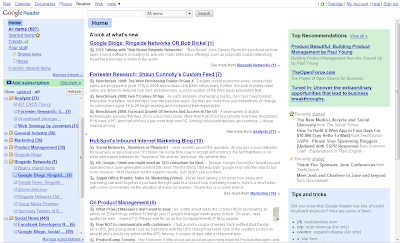
On the left, you will see that I have my Feeds organized into Folders (ex. Analysts, Product Management, Marketing, Ringside Networks, etc., etc.). This helps me organize the flow of information and enables me to keep on top of the more important folders (ex. keep their unread counts near zero).
So while I'm drinking my morning coffee, I read through they key areas and do a quick triage on the other folders to see if anything else is worth spending time on. If I want to flag an article for followup, I click on the Star in Google Reader, which adds it into the Starred Items list. I use this list as a lightweight way to keep track of links that I'd like to chew on for a while (ex. articles I may refer to in one of my future blog posts).
UPDATED: In response to requests for a "how-to" video, I posted "Google Reader In Action" which shows how to get started with Google Reader in less than 5 minutes. The video walks you through subscribing to search results on Google News, Google Blogs, and the Social Media Firehose.
How do I use Delicious?
Whenever I come across a web page or article worth bookmarking and sharing, I use the Delicious Toolbar Buttons to save a link to the article. I usually specify a one or two sentence description as well as one or or more tags.
More interestingly, I use Delicious to automagically populate the Recommended Reading section of the Ringside Networks Social Business web page.
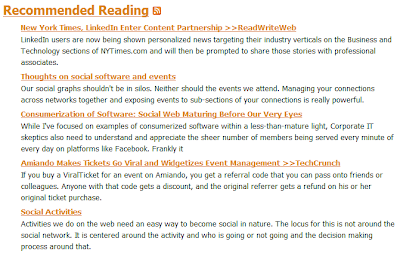
How does this work? I leverage the Delicious Linkrolls feature to show just the articles with the the Delicious "Recommended" tag within a specially formatted list. I also use this feature to keep track of notable mentions of Ringside Networks by the media. See the Ringside Networks Media Coverage section of the Ringside News page as well as the Delicious "RingsideBuzz" tag to see how this works.
What About Online Talking?
The list above is focused on online Listening and Sharing. I intentionally did not cover tools for online Talking (ex. Blogs, Wikis, Forums, IRC, Facebook, Twitter, etc.) since I believe people should get good at Listening and Sharing before making the leap to Talking. If you just can't wait to get started Talking, then I suggest you create a blog and post to it on at least a weekly basis. Also post comments in response to other people's blogs and articles, as well as answer questions on Forums.
UPDATED: For a good overview of why you should blog and how to go about it, read Gopal Shenoy's "Five reasons why I blog and my eight blogging recommendations".
How Are You Listening and Sharing?
Are you using any of the tools I mentioned above? If so, how are they working out for you? If not, what are you using? I'm always looking for tools that help me work smarter, so if you have any goodies, please share.
References
For your convenience, here is a list of the various tools and websites that I mentioned above:
So how can a Product Manager (or any business owner for that matter) be as efficient and effective as possible listening to the market? And how can they easily share the information they gather with other stakeholders interested in learning and understanding?
Below is a list of FREE tools/websites/tips I currently use for Listening and Sharing as part of my daily routine. Please note that RSS Feeds are at the heart of my system. If you are new to RSS, please read: Google Reader Help Center: What is a feed? What does it mean to subscribe? Also note that these tools do not replace but add information (in an automated, scalable manner) that complements my usual face to face/phone/email conversations with customers, prospects, partners, coworkers, etc.
1. Key Websites: Start off by creating a list of the best sources of online information (news, articles, opinions, blogs, online communities, industry analyst sites) for your product's industry, buyers, users, key influencers, etc. If you are drawing a complete blank, start with Alltop, which attempts to collect "all the top" stories across the web. Be sure to ask others (including some of your customers) what sites they read. Try to make a NICE BIG LIST and always keep your eyes and ears open for new sites to add to your list. You can always trim the noise and useless sources of information later. Be sure to include any public forums or online communities (ex. Facebook Groups) that are engaging in discussions related to your areas of interest.
2. Google Reader: Subscribe to as many of your Key Websites as possible using an RSS Feed Reader. I use Google Reader which is free and easy. Any good reader will do. If you don't already use an RSS Reader (ex. you subscribe to email alerts instead), then I strongly suggest you move this task out of Email and use RSS Feeds instead! Why? Because email is an inflexible closed system that is already likely overloaded; whereas RSS Feeds are designed to enable you to more easily GATHER, ORGANIZE and SHARE articles that you find useful with others. More details below on how I use Google Reader.
3. Google News and Blog Search: Your list of Key Websites is not enough. You need to identify the key terms for your area of focus and setup RSS Feeds from Google News and Google Blog Search (and any other useful search sites; such as Technorati) for the various search criteria that you want to track. You will likely setup multiple feeds across your search criteria (ex. your product, your competitors products, key industry terms, etc.). This is not an exact science, so it's OK to tweak your terms and recreate your feeds until you get a good flow of information going!
4. Delicious Social Bookmarking: While you can use the organization and favoriting features built into Google Reader, I prefer to use Delicious to store and organize my bookmarks. Click here to learn about Delicious and Social Bookmarking. The Delicious Toolbar Buttons (Bookmarklets) make the process of creating bookmarks easy. I use tags to help me organize my bookmarks. For example, look at my Ringside Networks Delicious page to see my favorite articles, and click on the "Recommended" tag to see how it displays only those articles tagged as "Recommended". If you don't like Delicious, Magnolia is another social bookmarking site worth considering. More details below on how I use Delicious.
5. Small and Shareable Links: Sometimes you want to share a link to an article that has a really long URL. I use TinyURL for turning long URLs into teeny-tiny URLs. So, http://www.pragmaticmarketing.com/blogs/productmarketing becomes http://tinyurl.com/2vzwqp. Be sure to setup the TinyURL Toolbar Button which makes creating a TinyURL just one click away. NOTE: I use TinyURL when I need a short URL and don't mind obfuscating (hiding) the original URL. I tend NOT to use TinyURL when I want/need to use the real links (ex. when referring to pages on my company website, I want to keep track of other sites that link to pages on my website).
6. Social Media Firehose: The Social Media Firehose leverages Yahoo Pipes to tap into what people are saying and sharing across the realm of Social Media (ex. Flickr, Twitter, Friendfeed, Digg, etc.). It's as simple as plugging in your search terms, any sites you want excluded from the search, and clicking Run Pipe. After the search runs, simply add it as a feed to your reader in order to track the conversations happening on the Social Web. For those interested in just searching Twitter conversations, Summize (now Twitter Search) is a good tool for doing just that.
7. Forums and Online Communities: If your company offers a User Forum or if you are aware of any independent forums focused on your area of interest, then you may want to subscribe to a feed focused on the the topic areas you are interested in. For example, the Ringside Networks forums are at http://forums.ringsidenetworks.org/ and I tune into the User Forums rather than the Developer Forums. When I was at JBoss, I also subscribed to the User Forums.
8. Social Following and Aggregation: If you have a handful of key people whose commentary you like to follow closely AND who use Friendfeed to aggregate their blogs, twitters, and other social activities, then you should create an account on Friendfeed and follow them. You can also subscribe to your Friendfeed feed within your reader, if you want.
9. Website and Content Analytics: Inbound Marketing (where you help yourself "get found" by people learning about and shopping in your industry) is an important process for small to midsize companies to understand. Since CONTENT is the fuel for the Inbound Marketing machine, it is critical for Product Managers and Product Marketers to understand who's viewing the content on their website, how they are finding the content, how often they are viewing, etc. Why? Because if you're going to spend time creating content, you should use tools to measure how successful / useful that content actually is. At JBoss, we used Eloqua and SalesForce.com as key components of our "marketing machine". We're a much smaller company at Ringside Networks, so I use Google Analytics to analyze website traffic, and I've been considering HubSpot to help me get fancier with improved search engine optimization, etc. HubSpot also offers two FREE tools worth mentioning: Website Grader and Press Release Grader. Both provide a nice summary of what's working and what can be improved. Finally, SEO Pro's Link Checker is a useful free tool that analyzes who is linking to your pages. Just plug in your link and after a little while it will list all of the places that link is referenced.
10. Private Wiki / Intranet: For the files and information that can not be stored publicly, leverage your corporate intranet or create a protected section off of your wiki. My main point here is for you to MOVE THE FILES AND INFORMATION THAT EXIST ONLY ON YOUR LAPTOP INTO AN ACCESSIBLE PLACE! Why? Because people get hit by busses. People leave companies. Other people could benefit from information you have...if it wasn't locked up on your laptop. Yes, you will need to keep some information private and on your laptop. For all of the other useful information, give it wings and make it free! At JBoss and Red Hat, I stored most of my useful yet private information on our Private Wiki (behind our firewall). NOTE: You can still leverage Social Bookmarking for links to files that are on your Intranet. Just remember that only fellow employees who have access will be able to view the documents; all others will get an error accessing the link.
So that's my list of tools and websites use for listening and sharing. Since Google Reader and Delicious are tools that I use day in and day out, let me go into a little more detail on how I use these important tools.
How do I use Google Reader?
Let's start with a screenshot of my Google Reader at this very moment:

On the left, you will see that I have my Feeds organized into Folders (ex. Analysts, Product Management, Marketing, Ringside Networks, etc., etc.). This helps me organize the flow of information and enables me to keep on top of the more important folders (ex. keep their unread counts near zero).
So while I'm drinking my morning coffee, I read through they key areas and do a quick triage on the other folders to see if anything else is worth spending time on. If I want to flag an article for followup, I click on the Star in Google Reader, which adds it into the Starred Items list. I use this list as a lightweight way to keep track of links that I'd like to chew on for a while (ex. articles I may refer to in one of my future blog posts).
UPDATED: In response to requests for a "how-to" video, I posted "Google Reader In Action" which shows how to get started with Google Reader in less than 5 minutes. The video walks you through subscribing to search results on Google News, Google Blogs, and the Social Media Firehose.
How do I use Delicious?
Whenever I come across a web page or article worth bookmarking and sharing, I use the Delicious Toolbar Buttons to save a link to the article. I usually specify a one or two sentence description as well as one or or more tags.
More interestingly, I use Delicious to automagically populate the Recommended Reading section of the Ringside Networks Social Business web page.

How does this work? I leverage the Delicious Linkrolls feature to show just the articles with the the Delicious "Recommended" tag within a specially formatted list. I also use this feature to keep track of notable mentions of Ringside Networks by the media. See the Ringside Networks Media Coverage section of the Ringside News page as well as the Delicious "RingsideBuzz" tag to see how this works.
What About Online Talking?
The list above is focused on online Listening and Sharing. I intentionally did not cover tools for online Talking (ex. Blogs, Wikis, Forums, IRC, Facebook, Twitter, etc.) since I believe people should get good at Listening and Sharing before making the leap to Talking. If you just can't wait to get started Talking, then I suggest you create a blog and post to it on at least a weekly basis. Also post comments in response to other people's blogs and articles, as well as answer questions on Forums.
UPDATED: For a good overview of why you should blog and how to go about it, read Gopal Shenoy's "Five reasons why I blog and my eight blogging recommendations".
How Are You Listening and Sharing?
Are you using any of the tools I mentioned above? If so, how are they working out for you? If not, what are you using? I'm always looking for tools that help me work smarter, so if you have any goodies, please share.
References
For your convenience, here is a list of the various tools and websites that I mentioned above:
Friday, August 1, 2008
Social Web Example: ROBLOX Virtual Playworld
In prior posts, I provided a definition of social web as well as how household-name businesses such as Jeep and Nike are embracing the social web in order to more closely engage their respective communities of passion.
In this post, I'd like to focus my attention on the intersection of the social web and online virtual worlds. While I find the recent news about 3D virtual worlds interesting, the highlighted examples such as Vivaty, Google’s Lively project, and the Electric Sheep Co.’s WebFlock feel a little empty and unremarkable from a "meaningful interactions" perspective.
I consider ROBLOX Virtual Playworld a much better example to explore. Why? Because it is an online destination that not only satisfies kids' social and entertainment needs but also addresses their hunger for creativity and learning.
To get a better feel for what ROBLOX is all about, just view the following video which illustrates ROBLOX in action:
Click here to view this video on YouTube.
ROBLOX enables 100's of thousands of kids to interact and play within virtual worlds while learning design, engineering, science and programming. I find the educational aspects so remarkable that I wrote a post earlier this year stating that ROBLOX was grooming our future open source developers.
Since that post, my son has spent countless hours designing, building, and scripting his own customized virtual worlds. For example, he created a very popular Baseball Stadium where you can almost smell the grass on the field while having fun throwing, fielding, and hitting the baseball. It is a modern stadium complete with hot dog stands and a giant blimp hovering over it.
He spends a lot of time using the ROBLOX Studio development environment PROGRAMMING the behavior of the elements/objects within his worlds. For example, he creates complex 3D behaviors within the world by calling mathematical functions that enable the bat, for example, to swing at a wide variety of angles rather than just back and forth. He also adjusts the impact on the ball so that it bounces off at varying speeds.
He leverages the "social" features of the site (beyond the Forum, Wiki, and Blog) including "friending" other people on the site, sending email-like messages to each other in order to ask and answer questions, chatting online while playing within a particular world, voting for "favorite places", etc.
Using my 7 Key Attributes of Social Web Applications, I think ROBLOX scores pretty well. Every user has an Identity; the information is not rich likely due to the fact that we are dealing with kids so onlineprovacy is important. Their Reputations are based on how they conduct themselves online as well as the quality of the places and/or scripts they create. They don't offer much in the way of Presence. People can strike up Relationships with eachother, but not nearly as robust as what you get on sites like Facebook. You can't really Group your friends as far as I can tell. Conversations happen via Forums, chat, and their built in email/messaging system. And Sharing happens all the time since people can share objects, scripts, places, etc.
ROBLOX Business Model
Standard membership in ROBLOX is free and provides the ability for kids to receive an avatar, play within the worlds, as well as design, build, and save a single place of their own. ROBLOX also offers Builders Club which is a premium service that gives kids the ability to create and manage multiple places. It also enables players to earn ROBLOX currency (called "ROBUX") which can be used to purchase premium items in the ROBLOX catalog that enable much greater customization of avatars and interactive creations. I like the fact that ROBLOX offers a free way for kids to get started and then charges extra for increased value.
Bottom-line: ROBLOX provides a great example of how combining the social web and online virtual worlds provides value beyond entertainment and social interactions. As they say on their website, ROBLOX believes "in the theory that kids learn best by making things - by engaging in the creative and complex process of imagining, designing, and constructing. Provide them with a safe and nurturing place to build, give them the requisite tools, and let them play."
NOTE: ROBLOX has a great web page for parents who want to learn more.
Wednesday, July 30, 2008
i-legions Commits Brand Suicide?
I stumbled across an article by Jennifer Leggio of ZDNet that illustrates the art of brand suicide in this day and age of the social web:
‘Branded community’ leads to trademark morass
Basically, Jennifer received a cease and desist letter from i-legions claiming that her use of the phrase "branded community" constitutes trademark infringement. Denise Howell of ZDNet commented on this issue and provided a good link regarding Trademarks.
Legalese aside, what makes this situation precious is the irony involved.
i-legions is "The only company whose Branded Communities® generate real revenue as they enhance user interaction with your brand".
The letter from i-legions was specifically in response to an article entitled "Enterprise communities: build or join?" which highlights Mzinga, a provider of online communities and social networks for businesses. One could say they help companies build "branded communities".
That means...Mzinga...is....a competitor. Aha, now I get it!
So rather than compete on the value of their solution, i-legions' recipe for social web success is to legally govern what people can and can't say. Do I have that right? Well, that makes perfect sense since i-legions, after all, is "The only company whose Branded Communities® generate real revenue...".
So, while i-legions positions themselves as social web leaders and brand experts, I hope their advice to their prospective customers regarding this issue is to "do as I say and not as I do".
SIDE NOTE
Trademark infringement is an important issue to understand, and I am on record regarding the importance of protecting trademarks. See my What Do You Stand For? post regarding the Hibernate trademark.
This i-legions situation, however, is not about infringing on an established product name, company logo, etc. Instead it appears focused on someone's ill-informed desire to govern the "descriptive fair use of words in the English language" (i.e. not trademark infringement)...especially by [or in reference to] their competitors.
Tuesday, July 22, 2008
Product Management Tips for Listening and Sharing
Reposted as "10 Tips for Listening and Sharing on the Web".
Read "Do Blog Post Titles Matter?" for why this article was reposted.
Read "Do Blog Post Titles Matter?" for why this article was reposted.
Monday, July 21, 2008
Wrapping My Head Around Microsoft Live Mesh
In late April, I started seeing interesting articles regarding Microsoft's Live Mesh that were stating that Microsoft "is bringing its developers onto the Internet in an interesting new way" with Live Mesh. My gut was telling me that this was important stuff, but I did not have the time to dig in.
In May, my gut started rumbling again after Matt Asay (whom I'm a big fan of) posted "Where did Microsoft's ambition go?". The key parts of his post that stuck with me were:
"Microsoft does need ambition on the web....makes me think the company has too much cash to be able to see a future where it's largely irrelevant, awash in tablets but a nonentity on the web that stitches them together."
No offense Matt, but based on my experience over the past two decades, one should never, ever count Microsoft out. Ever. Remember OS/2, remember Netware, remember Netscape?
Since I've been spending the better part of this year focused on the Social Web, I left myself a todo to spend some time figuring out Live Mesh, especially after reading the "Full text of Ray Ozzie Mesh Memo". The quote that stuck with me was:
"Community on the web once meant “group communications”, largely through rudimentary tools such as email, IM and IRC, message boards and newsgroups. Today, the action has shifted toward using composite communications tools and platforms that mash together content, applications and commerce, all within the context of group interaction. These social platforms are altering the way we connect and coordinate, establish identity and affinities, and build reputation."
That quote showed me that Microsoft (or at least Ray Ozzie) gets it! So, if Microsoft is able to execute on this vision, they will resurrect themselves once again.
Anyhow, over the weekend I finally spent time on my todo. I came across a very informative video by Ori Amiga from Microsoft that really helped me understand Microsoft's Live Mesh strategy and MOE (the Mesh Operating Environment). In the hour-long "Programming the Mesh" video, Ori shows a number of demos covering the native Mesh feeds, applications using Mesh, a Silverlight client that supports working on and offline, a custom Facebook application that syncs Facebook photos with Live Mesh, a Mac client that sends photos to Live Mesh, and LINQ queries over Mesh objects.
Pretty...cool...stuff.
I also read an article by Steve Gillmor on TechCrunchIT , where he stated that Microsoft Live Mesh is "essentially a rewrite of Notes replication over open protocols with FeedSync combined with an atomization of social media primitives into a new platform on which to build applications that are identity rather than hardware or native OS-centric. Today, we see Live Mesh as about virtualizing files from the containing device over a Web hub, but at a deeper level, the Mesh is as much an information router as a bit traffic cop. How to act on the data becomes more strategic than the underlying job of moving things around to follow the user."
It is great to see that Microsoft realizes the importance of weaving basic social primitives into the experience of the users of their platforms. You can be sure that I will be following the progress of Live Mesh as it continues its rollout over the coming quarters.
Bottom-line: I just knew when I joined Ringside Networks that we were at the center of something pretty big. Folks like Google and Facebook get it...and what I've seen of Live Mesh, I believe Microsoft gets it as well.
Thursday, July 17, 2008
Consumerization of Software: Social Web Maturing Before Our Very Eyes
Fueled by our use of Amazon, eBay, Facebook, Google, iTunes, Twitter, YouTube, etc., the consumerization of software has been a growing movement over the past few years. The benefit of this wave is software that is more engaging and intuitive. No expensive training required.
Most of these next-generation websites and applications sit at the heart of the Social Web, and whether corporate IT likes it or not, many employees are using these consumer technologies during work hours.
Having spent many years in the enterprise software space, I realize that corporate IT prefers MATURE technologies. So, let's take a look at two examples (Twitter and Facebook) of how things are maturing within the Social Web Landscape.
Twitter
Just scour through Twitter to see how people/workers have been using it to communicate their whereabouts, thoughts, opinions, among other things. You also don't have to look very hard to read about Twitter's repeated issues with scalability and downtime. The issues have happened often enough that some have moved away from Twitter to Friendfeed; choice is good.
Believe it or not, I am happy to see the issues with Twitter's scalability and the resulting uproar from the consumers. Why? Because it is useful for people to be reminded that anything on the web that becomes popular so fast has to deal with scaling issues that can derail it. So plan for it and be ready to deal with it.
Moreover, I believe the public airing of the dirty laundry helps drive things more quickly towards improvement; which in turn helps the overall market mature more quickly. Finally, Twitter's move to acquire Summize is just another proof point of how quickly this market is maturing.
Facebook
Another potential saga worth watching is Facebook's rollout of its latest round of [pretty extensive] changes to the Facebook Platform. Let me draw your eye to an interesting thread on the Facebook Platform Developer Forum.
The Facebook Platform team posted "We're Launching the New Profile Design to Users Very Soon":
"This is a quick heads up that we're going to start opening the new profile design to selected users. We're finalizing all the code, and the profile will be available to users you can see as soon as 24 hours from now, though it might take a few days before you see any of your users on the new site as they decide to opt in. So get your applications ready!"
Just look at some of the responses:
Conclusion
While I've focused on examples of consumerized software within a less-than-mature light, Corporate IT skeptics also need to understand and appreciate the sheer number of members being served every minute of every day on platforms like Facebook. Frankly it is mind-numbingly impressive. Furthermore, I'd argue that Facebook is a great example of Web 2.0 and SOA in action; this is not tinker-toy software. But that's a blog for another day.
Bottom-line: The consumerization of software is well underway, and it is fascinating to watch as the Social Web matures before our very eyes.
Most of these next-generation websites and applications sit at the heart of the Social Web, and whether corporate IT likes it or not, many employees are using these consumer technologies during work hours.
Having spent many years in the enterprise software space, I realize that corporate IT prefers MATURE technologies. So, let's take a look at two examples (Twitter and Facebook) of how things are maturing within the Social Web Landscape.
Just scour through Twitter to see how people/workers have been using it to communicate their whereabouts, thoughts, opinions, among other things. You also don't have to look very hard to read about Twitter's repeated issues with scalability and downtime. The issues have happened often enough that some have moved away from Twitter to Friendfeed; choice is good.
Believe it or not, I am happy to see the issues with Twitter's scalability and the resulting uproar from the consumers. Why? Because it is useful for people to be reminded that anything on the web that becomes popular so fast has to deal with scaling issues that can derail it. So plan for it and be ready to deal with it.
Moreover, I believe the public airing of the dirty laundry helps drive things more quickly towards improvement; which in turn helps the overall market mature more quickly. Finally, Twitter's move to acquire Summize is just another proof point of how quickly this market is maturing.
Another potential saga worth watching is Facebook's rollout of its latest round of [pretty extensive] changes to the Facebook Platform. Let me draw your eye to an interesting thread on the Facebook Platform Developer Forum.
The Facebook Platform team posted "We're Launching the New Profile Design to Users Very Soon":
"This is a quick heads up that we're going to start opening the new profile design to selected users. We're finalizing all the code, and the profile will be available to users you can see as soon as 24 hours from now, though it might take a few days before you see any of your users on the new site as they decide to opt in. So get your applications ready!"
Just look at some of the responses:
- "We would appreciate it if you are able to make the new profile design at http://www.new.facebook.com/ fully functional and let us test our apps for a few days before opening it up to users. You and all of us risk alienating users if you open up the current new design to users already, and they start seeing broken features, both from you and from our apps, right?"
- "Facebook should consider itself as an operating system. We are the app designers. Right now, the operating system designers are doing a poor and unprofessional job at releasing new functionality. In the end, it is the users who will be hurt....Are you listening, Facebook?"
- "I don't think Facebook could have handled this transition any worse. Every time I have looked into doing some work to move our apps to new API, I have run into issues/bugs and have just given up. Facebook needs to: 1. Get their stuff together and working. 2. Once they have the functionality working and more importantly documented properly, so all the Facebook API libraries can be upgraded (not just PHP), then they need to give the developers 1 month to upgrade and test their apps. The 1 month time should only start after they have a good beta in working condition.... 3. And only then they should start opening up the new system to the users, and that too in phases. Hopefully someone in Facebook is going to wakeup and realize this is a major mess as of now."
Conclusion
While I've focused on examples of consumerized software within a less-than-mature light, Corporate IT skeptics also need to understand and appreciate the sheer number of members being served every minute of every day on platforms like Facebook. Frankly it is mind-numbingly impressive. Furthermore, I'd argue that Facebook is a great example of Web 2.0 and SOA in action; this is not tinker-toy software. But that's a blog for another day.
Bottom-line: The consumerization of software is well underway, and it is fascinating to watch as the Social Web matures before our very eyes.
Monday, June 30, 2008
Social Web Market: The Long Tail, Skinny Head, and Beefy Middle
I read an interesting article by Chris Anderson entitled "Debating the Long Tail". In it he responds to an article by Anita Elberse, a Harvard Business School associate professor, who challenges his long tail theory's predictions.
The difference of opinions arises from the fact that they have different perspectives on where the head ends and the tail begins...which actually dovetails nicely with how I've been explaining to people where Ringside Networks fits within the Social Web Market Landscape.
I start off by drawing the standard long tail diagram. In my diagram, I refer to the Skinny Head which is where the "blockbusters" reside that Anita Elberse writes about. We also, of course, have the Long Tail which is where the large volume of niche offerings exist. I add a section, however, between the two that I refer to as the Beefy Middle.

The Beefy Middle changes some of the debate of where the head ends and the tail begins since it provides an area between the two. Let's look at a diagram of the Social Web Market Landscape to get a better feel for what the Beefy Middle entails. The # of Sites is on the X-Axis and the # of Profiles (i.e. registered users) is on the Y-Axis:

The Social Web's Skinny Head is the domain of the large social networking sites such as Facebook, MySpace, Hi5, Orkut, and LinkedIn. It also houses the most popular social applications such as YouTube, Flickr, Delicious, and Digg. These represent the major hubs of the social web.
The Social Web's Long Tail is the domain of personal blogs, websites, and simple social web widgets and gadgets. Google Friend Connect and Facebook Connect define the far left of the Long Tail since they are designed to bring social capabilities to the long tail of simple websites.
This leaves the Social Web's Beefy Middle. This area is where most corporate websites reside. This is the market area that Ringside Networks is focused on as well as solutions from companies such as Acquia (i.e. Drupal), Jive, and Lithium.
The websites that reside in the Beefy Middle already have their own database of registered users (thousands, tens of thousands, hundreds of thousands) along with some semblance of profile data (i.e. credit card info, newsletter registration, etc.). It is usually NOT desirable for these websites to create a social network that is separate from and does not reside on their existing web property. These companies want/need to integrate their existing users within a larger social context.
Moreover, these companies have their own systems that manage their own content and data which is further reason for using a social web solution that integrates well with their existing systems.
Finally, these sites typically have web applications (or are planning web applications) that they would like to enhance to have a social context that enables the applications to connect to and run on multiple sites including the major social networks like Facebook.
The market requirements of the Beefy Middle are challenging since it is almost a given that the existing registered users are already socially represented on two or three of the Skinny Head sites as well as countless sites across the Beefy Middle and Long Tail.
This means that these companies need to define a social web strategy that enables their website to operate as a spoke that can easily plug into the major social web hubs. They also need to give their registered users the ability to map their social identities to the social hub(s) of their choice. This minimizes duplication of profile data and maximizes the ability of users to quickly and easily engage their broad network(s) of friends.
So there you have it; the Long Tail, Skinny Head...and Beefy Middle. My guess is the term "Beefy Middle" won't be as widely used as "Long Tail", but hopefully it helps illustrate the portion of the market that Ringside Networks is focused on serving.
UPDATED: Seth Godin recently posted "The Long Tail and the Dip" in which he describes an area that exists between the Head and the Long Tail. He refers to it as "the second pocket" which is where successful, profitable niche products exist. It's cool that Seth sees the need to discuss this region of the market...but hey Seth...it's called the Beefy Middle! :-)
If you'd like to learn more about how Ringside Networks addresses the needs of companies in the Beefy Middle, please check out the Social Business section of the Ringside Networks website for a range of examples and articles related to the rapidly moving business of the Social Web.
Wednesday, June 25, 2008
Social Window Shopping
Back in the stone ages (i.e. before the Internet), people would get together with their friends for a day of window shopping.
 Going from store to store, comparing and contrasting the alternatives, placing items of interest on layaway, and ultimately making a purchase based on the input of friends.
The web, of course, has changed this dynamic by making it very easy to shop online. Sites like Amazon.com have User Ratings and Reviews applications that allow any member to post their thoughts on a particular item. They also have Wishlist applications that enable people to set aside items that they are considering for purchase.
While these applications provide a great source of information to the shopper, they are still missing the crux of what made window shopping so powerful; namely the input and social camaraderie of friends.
Why is this important? Well, if you look at the chart below from Forrester's "Data Chart of the Week: Who Do People Trust?", you will see that the opinions of friends or acquaintances who have used the product or service is what people value and trust the most.

With the advent of the Social Web, we are at a point where e-commerce websites can start to bring the power of social interactions back to the shopping process.
Social Window Shopping Example
Let's look at an example where you are shopping for running shoes on Sneaks4Geeks.com. You've narrowed your search down to your top three choices by reading all of the anonymous reviews and ratings. It's time to kick it up a notch and get your friends involved!
While you already have some friends on Sneaks4Geeks, you also want to get the opinions of your running friends on Facebook and the Nike+ community.
Sneaks4Geeks uses this really cool Social Window Shopping application that enables people to interact with and get shopping advice from their friends on a range of social sites. The Window Shopping application developers had the mentality of "write once, social everywhere" when they created the application, so they chose Ringside Networks to help them achieve this goal.

So on Sneaks4Geeks you add your top three running shoe choices into the Window Shopping application and reach out to your running friends on Sneaks4Geeks, Facebook, and Nike+. You include the note: "Help me choose! I'm considering the following running shoes for the Broad Street Run in May. What's your favorite?".
Since the Window Shopping application is also integrated into Facebook and Nike+, my friends across all of these sites can respond to my request from within the Window Shopping application available on their particular site. They place their vote for one of the running shoes and provide an insightful comment back.
After a little while, you tally the votes, read the comments, and make your purchase based on the input of your network of friends. For those friends who responded with an opinion, the Window Shopping application automatically thanks them and shares the results of your purchase.
You happily trot off with a new pair of running shoes, and your shopping experience reminds two of your friends that their running shoes are getting pretty worn out...maybe it's time for them to get some new running shoes from Sneaks4Geeks!
Conclusion
For any Social Web initiative to succeed, it is important to find the area of passion that will truly drive social engagement. In the example above, enabling people to shop and interact with friends for their thoughts and opinions touches on a critical area of passion for many people.
Please visit the Social Business section of the Ringside Networks website for more articles on the Social Web and to learn more about how Ringside Networks helps facilitate scenarios such as the Social Window Shopping example covered above.
 Going from store to store, comparing and contrasting the alternatives, placing items of interest on layaway, and ultimately making a purchase based on the input of friends.
The web, of course, has changed this dynamic by making it very easy to shop online. Sites like Amazon.com have User Ratings and Reviews applications that allow any member to post their thoughts on a particular item. They also have Wishlist applications that enable people to set aside items that they are considering for purchase.
While these applications provide a great source of information to the shopper, they are still missing the crux of what made window shopping so powerful; namely the input and social camaraderie of friends.
Why is this important? Well, if you look at the chart below from Forrester's "Data Chart of the Week: Who Do People Trust?", you will see that the opinions of friends or acquaintances who have used the product or service is what people value and trust the most.
With the advent of the Social Web, we are at a point where e-commerce websites can start to bring the power of social interactions back to the shopping process.
Social Window Shopping Example
Let's look at an example where you are shopping for running shoes on Sneaks4Geeks.com. You've narrowed your search down to your top three choices by reading all of the anonymous reviews and ratings. It's time to kick it up a notch and get your friends involved!
While you already have some friends on Sneaks4Geeks, you also want to get the opinions of your running friends on Facebook and the Nike+ community.
Sneaks4Geeks uses this really cool Social Window Shopping application that enables people to interact with and get shopping advice from their friends on a range of social sites. The Window Shopping application developers had the mentality of "write once, social everywhere" when they created the application, so they chose Ringside Networks to help them achieve this goal.

So on Sneaks4Geeks you add your top three running shoe choices into the Window Shopping application and reach out to your running friends on Sneaks4Geeks, Facebook, and Nike+. You include the note: "Help me choose! I'm considering the following running shoes for the Broad Street Run in May. What's your favorite?".
Since the Window Shopping application is also integrated into Facebook and Nike+, my friends across all of these sites can respond to my request from within the Window Shopping application available on their particular site. They place their vote for one of the running shoes and provide an insightful comment back.
After a little while, you tally the votes, read the comments, and make your purchase based on the input of your network of friends. For those friends who responded with an opinion, the Window Shopping application automatically thanks them and shares the results of your purchase.
You happily trot off with a new pair of running shoes, and your shopping experience reminds two of your friends that their running shoes are getting pretty worn out...maybe it's time for them to get some new running shoes from Sneaks4Geeks!
Conclusion
For any Social Web initiative to succeed, it is important to find the area of passion that will truly drive social engagement. In the example above, enabling people to shop and interact with friends for their thoughts and opinions touches on a critical area of passion for many people.
Please visit the Social Business section of the Ringside Networks website for more articles on the Social Web and to learn more about how Ringside Networks helps facilitate scenarios such as the Social Window Shopping example covered above.
Tuesday, June 24, 2008
Social Web Tip: Start With Passion
In my past two posts, I wrote about two very successful social web communities, the Jeep Community and the Nike+ Community.
What do these communities have in common besides well known and established brands?
PASSION
Just look through all of the pictures and videos posted by the Jeep community to get an idea of how ravenously passionate they are about their Jeeps. Similarly, the Nike+ running community just loves getting together for running events, talking about the latest running gear, etc.
Jeep and Nike are big companies with established brands and healthy, growing communities.
How about we look at an example where the seeds of passion are just being planted?
I recently caught up with a friend of mine who has launched a new site called Greenthumbr:

Bob McWhirter loves gardening and while he has only just started building the Greenthumbr community, the world is definitely full of people who love everything green too. So he has fertile ground upon which to grow a thriving membership.
Passion comes in big and small packages. Moreover, passion can start relatively small, but with the help of the social web, BIG things can happen!
Look at Barack Obama's rise to prominence as a perfect example of how the social web can amplify passion. While some people knew about Barack Obama 18 months ago, his MyBarackObama.com website as well as his Barack Obama Facebook page have attracted and energized millions of active and passionate followers.
So, my social web tip for you is to find the PASSION in your community and feed it, nurture it, encourage it, revel in it, wallow in it. And before long, you just might see the strong roots of a thriving social web community take hold.
What do these communities have in common besides well known and established brands?
PASSION
Just look through all of the pictures and videos posted by the Jeep community to get an idea of how ravenously passionate they are about their Jeeps. Similarly, the Nike+ running community just loves getting together for running events, talking about the latest running gear, etc.
Jeep and Nike are big companies with established brands and healthy, growing communities.
How about we look at an example where the seeds of passion are just being planted?
I recently caught up with a friend of mine who has launched a new site called Greenthumbr:
Bob McWhirter loves gardening and while he has only just started building the Greenthumbr community, the world is definitely full of people who love everything green too. So he has fertile ground upon which to grow a thriving membership.
Passion comes in big and small packages. Moreover, passion can start relatively small, but with the help of the social web, BIG things can happen!
Look at Barack Obama's rise to prominence as a perfect example of how the social web can amplify passion. While some people knew about Barack Obama 18 months ago, his MyBarackObama.com website as well as his Barack Obama Facebook page have attracted and energized millions of active and passionate followers.
So, my social web tip for you is to find the PASSION in your community and feed it, nurture it, encourage it, revel in it, wallow in it. And before long, you just might see the strong roots of a thriving social web community take hold.
Monday, June 23, 2008
Social Web Example: The Nike Plus Community
In a prior post, I provided a definition of social web. Some may read that post and ask the question: "But are real companies actually embracing the social web?"
The answer is an unequivocal: Absolutely!
I have already illustrated how the Jeep Community is an extension of Jeep.com that engages its passionate community directly as well as promotes the large number of Jeep communities that exist on social web sites like Facebook, Yahoo, etc.
The Nike+ Community is similar in that it engages its passionate member community directly from its own website. It is different in that it does not overtly interlink with other Nike communities that exist on other social web sites. At least not nearly as much as the Jeep Community site does.
The picture below shows the entry point for runners to track their mileage. A cool feature is the Community mileage counter that is constantly counting up the collective mileage posted by the Nike+ community. Kind of reminiscent of the McDonald's "100 Million Served" counter. Neat touch.

The next picture shows the entry point for finding and sharing events that the Nike community would be interested in. Nike clearly wants to encourage their community to run together and interact.

Nike also provides an information-rich blog entitled "Inside Nike Running". They have experts writing on a range of topics. So for the community members who primarily like to read and listen, they have a great resource. Nike also provides a Forum for members who are more vocal and want to share their own thoughts.

While the site is a little over-polished for my tastes, it absolutely provides a branded way for Nike to engage its community around an area of PASSION.
I searched on Facebook to get a feel for how Nike is expanding its Nike+ community by engaging with Facebook members directly. While there are a variety of Nike+ groups created on Facebook (ex. the "Nike+ Challenges" group), none of them appear to have a lot of momentum which may be due to the fact that the Nike+ website already has a lot of engaging content.
I really like the "Nike+ Running Monitor" Facebook application and how it connects Facebook and Nike+ website members.
"The Nike+ Running Monitor is connected to the Nike+ website, giving you the ability to share your running information with the Facebook Network.You have the ability to add your profile summary, runs, goals, challenges and much more so you can show off how well you are doing and to keep you inspired!"
Nike clearly has a great strategy for engaging its passionate community with useful information and tools that enable them to feel part of the larger community. If you look at each of the screenshots above, you will also see how Nike makes it easy for community members to find their running products and learn more about them. It's a great noninvasive way to market/advertise to people who actually care about the products.
What's the bottom-line benefit to Nike? Customer loyalty, word of mouth referrals, increased brand equity, and increased sales. They also likely have a much higher ROI on their product-related advertising since they are engaging well qualified customers directly.
Further Reading:
Why Build Social Applications into a Website?
Why Develop a Facebook Application?
Social Media: Rent or Own?
Search Advertising vs. Social Applications
You can find even more recommended reading in the Social Business section of the Ringside Networks website.
The answer is an unequivocal: Absolutely!
I have already illustrated how the Jeep Community is an extension of Jeep.com that engages its passionate community directly as well as promotes the large number of Jeep communities that exist on social web sites like Facebook, Yahoo, etc.
The Nike+ Community is similar in that it engages its passionate member community directly from its own website. It is different in that it does not overtly interlink with other Nike communities that exist on other social web sites. At least not nearly as much as the Jeep Community site does.
The picture below shows the entry point for runners to track their mileage. A cool feature is the Community mileage counter that is constantly counting up the collective mileage posted by the Nike+ community. Kind of reminiscent of the McDonald's "100 Million Served" counter. Neat touch.
The next picture shows the entry point for finding and sharing events that the Nike community would be interested in. Nike clearly wants to encourage their community to run together and interact.
Nike also provides an information-rich blog entitled "Inside Nike Running". They have experts writing on a range of topics. So for the community members who primarily like to read and listen, they have a great resource. Nike also provides a Forum for members who are more vocal and want to share their own thoughts.
While the site is a little over-polished for my tastes, it absolutely provides a branded way for Nike to engage its community around an area of PASSION.
I searched on Facebook to get a feel for how Nike is expanding its Nike+ community by engaging with Facebook members directly. While there are a variety of Nike+ groups created on Facebook (ex. the "Nike+ Challenges" group), none of them appear to have a lot of momentum which may be due to the fact that the Nike+ website already has a lot of engaging content.
I really like the "Nike+ Running Monitor" Facebook application and how it connects Facebook and Nike+ website members.
"The Nike+ Running Monitor is connected to the Nike+ website, giving you the ability to share your running information with the Facebook Network.You have the ability to add your profile summary, runs, goals, challenges and much more so you can show off how well you are doing and to keep you inspired!"
Nike clearly has a great strategy for engaging its passionate community with useful information and tools that enable them to feel part of the larger community. If you look at each of the screenshots above, you will also see how Nike makes it easy for community members to find their running products and learn more about them. It's a great noninvasive way to market/advertise to people who actually care about the products.
What's the bottom-line benefit to Nike? Customer loyalty, word of mouth referrals, increased brand equity, and increased sales. They also likely have a much higher ROI on their product-related advertising since they are engaging well qualified customers directly.
Further Reading:
Why Build Social Applications into a Website?
Why Develop a Facebook Application?
Social Media: Rent or Own?
Search Advertising vs. Social Applications
You can find even more recommended reading in the Social Business section of the Ringside Networks website.
Subscribe to:
Posts (Atom)