
On Tuesday January 8, our awesome JBoss development team released JBoss Enterprise Application Platform 4.3. Kudos to the entire team for another great effort!
JBoss EAP 4.3 was a customer-driven release. The top two requests from our JBoss EAP 4.2 customers were to upgrade our messaging and web services technologies, and the team delivered.
JBoss Messaging provides a high performance messaging infrastructure and is a fantastic upgrade over the prior JBossMQ component. While JBossMQ has served us well over the past few years, JBoss Messaging is now the messaging architecture for JBoss EAP 4.3, 5.0, and beyond.
JBoss Web Services now fully supports JAX-WS which will really satisfy many of our customers. This also further rounds out our Java EE 5 capabilities.
JBoss EAP 4.3 includes JBoss AS, Hibernate, JBoss Seam, and many other components; more details can be found at http://www.jboss.com/products/platforms/application/components.
JBoss EAP 4.3 has been tested with many different operating systems and databases; more details can be found at http://www.jboss.com/products/platforms/application/testedconfigurations.
Documentation and Release Notes can be found at http://www.jboss.com/docs/index
For existing customers, the new release is available on both the JBoss Customer Support Portal and Red Hat Network.
Subscriptions for JBoss Enterprise Application Platform are immediately available directly from Red Hat, on the Red Hat Store, or from Red Hat resellers. For more information, visit http://www.jboss.com/products/platforms/application.
Thursday, January 10, 2008
Tuesday, December 18, 2007
JavaPolis, JBoss, and JSF
Catching up on news from this year's JavaPolis brought me to the results of the whiteboard votes that were conducted.
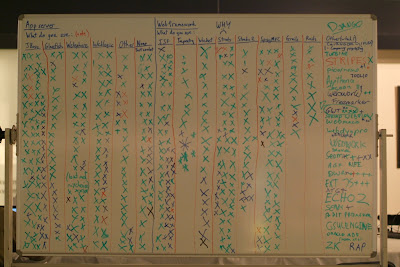
JBoss came out as top vote getter for the "which application server do you use?" whiteboard vote. The vote results were:
- JBoss = 85
- WebSphere = 47
- WebLogic = 45
- Just Servlet = 38 (I guess this is Tomcat?)
- Other = 31
- GlassFish = 24
Whiteboard photo for Application Servers and Web Frameworks

I especially like the almost apologetic comment in the WebSphere column: "but not my choice".
The results of "which web framework do you use" voting was also interesting in that the top 3 frameworks were:
- JSF = 60
- Struts = 60
- Spring MVC = 58
Since the new JBoss Developer Studio provides Eclipse tooling for JBoss Seam, JSF, Struts, and Spring...as well as includes the JBoss Enterprise Application Platform...it's cool to see how our new offering hits the mark on the most popular application server platform and web frameworks out there.
Thanks to the folks at JavaPolis for sharing these whiteboard results. Pretty cool and easy way to poll the attendees!
Saturday, December 1, 2007
Golden: Commercial Open Source - Can It Scale?
Bernard Golden of Open Source Maturity Model (OSMM) fame had a similar reaction as I did to the blog by Savio Rodrigues that asserts OSS business models don't scale.
I countered Savio's assertion with "Scaling a Software Business (open source or otherwise)".
Bernard Golden countered Savio's assertion with "Commercial Open Source - Can It Scale?" where he makes a range of worthwhile points:
I countered Savio's assertion with "Scaling a Software Business (open source or otherwise)".
Bernard Golden countered Savio's assertion with "Commercial Open Source - Can It Scale?" where he makes a range of worthwhile points:
"What this strikes me as is a failure to really come to terms with what open source means to IT, and, by extension, the software industry. It is judging open source by the standards of proprietary software business models and finding it lacking, instead of thinking through what business opportunities are made possible by the new mode of software distribution."
"His argument fails to fully comprehend the power of price elasticity, richly explored by Clayton Christensen; simply put, reduced prices don't mean less money is spent on a given item; reduced prices increase the customer base by more than enough to increase total market spend."
"What is important to recognize about all of these open source businesses is that they follow a publishing model and sell subscriptions. And, like all subscription-based businesses, they scale slowly, but are, nevertheless, able to grow to very large scale and can be phenomenally profitable... By contrast, licensed software companies can grow much faster, but tend to have problems later on when it becomes difficult to find new customers to fork over large upfront signing fees."
"The key to successfully scaling a software business (and this is true for both open source and proprietary software businesses) is to generate sufficient leads and to efficiently manage them well enough to create a viable business, defined as sufficiently profitable on a sufficient revenue base. An efficient sales process, applied to the very large lead base made possible by price elasticity, can certainly achieve success on even a 3% close rate."
"We haven't even begun to see the potential for commercial open source (or for that matter, community open source). It will so transform the IT landscape that, in the not-too-distant future, we'll look back on the bit-coercive proprietary software world and marvel that it existed at all - and that it was so small."
Mr. Golden states much more elegantly what many of us OSS vendors have been saying for a while now. And as he points out, the landscape is still changing...which should make the next few years a lot of fun.
Thursday, November 29, 2007
Scaling a Software Business (open source or otherwise)
OK, I've grabbed the bait Savio Rodrigues (of Big Blue fame) has cast for me. Savio's a good guy and we've traded opinions in the past, so here we go again.
Savio asserts "The OSS business model is great to grow from $0-$50M, but very difficult if you're trying to get to $100M.".
In my inimitable Philly style, my response is: Dude, that same statement can be made of most software companies, open source or not.
Let me use Princeton Softech (non open source) as an example. I was there before JBoss, and my focus was to help them grow to $50M and beyond. So I helped build and launch their database archiving solutions for Oracle E-Business, PeopleSoft, Siebel, and JD Edwards. In order to scale the business, we expanded our footprint beyond the generic archiving solution, to application-specific solutions. This scaled the business and increased valuation enough to entice your Big Blue to buy them recently...so be sure to treat my friends well! ;-)
So let me now use JBoss and Red Hat as examples.
To establish and build the business, you've got to start with great technology and A players. You then need to focus your business model on selling the right stuff. In the case of JBoss, we sold 75% subscriptions, 15% training, 10% consulting. Why? Because subscriptions have higher margins than training and consulting.
Once you've got momentum going on one product, you scale the business by:
On top of that, Red Hat has a pretty cool strategy for the RHEL business, has a solid Channel focus that includes JBoss, and offers a global reach.
All of that adds up to a multi-product line company with decent reach. You take that into customer conversations and you're able to drive strategic decisions rather than single product discussions.
[Added on Dec 1]
To those who think “The support-only OSS business model does not scale.”. Uhhh…I disagree. It may take a while to build up a base, but once you do and you can keep renewals at a good level, it’s a very scalable model. It's actually quite similar to the maintence revenues traditional software companies treasure. The subscription model is the gift that gives day in/day out.
IBM is famous for its 10 year strategies, so I encourage you to visualize this over the long term and let me know if you're still having problems seeing the model scale.
Savio asserts "The OSS business model is great to grow from $0-$50M, but very difficult if you're trying to get to $100M.".
In my inimitable Philly style, my response is: Dude, that same statement can be made of most software companies, open source or not.
Let me use Princeton Softech (non open source) as an example. I was there before JBoss, and my focus was to help them grow to $50M and beyond. So I helped build and launch their database archiving solutions for Oracle E-Business, PeopleSoft, Siebel, and JD Edwards. In order to scale the business, we expanded our footprint beyond the generic archiving solution, to application-specific solutions. This scaled the business and increased valuation enough to entice your Big Blue to buy them recently...so be sure to treat my friends well! ;-)
So let me now use JBoss and Red Hat as examples.
To establish and build the business, you've got to start with great technology and A players. You then need to focus your business model on selling the right stuff. In the case of JBoss, we sold 75% subscriptions, 15% training, 10% consulting. Why? Because subscriptions have higher margins than training and consulting.
Once you've got momentum going on one product, you scale the business by:
- Expanding your footprint (new products, product lines, solutions, etc.)
- Expanding your reach (channel business, partners, geographies, etc.)
On top of that, Red Hat has a pretty cool strategy for the RHEL business, has a solid Channel focus that includes JBoss, and offers a global reach.
All of that adds up to a multi-product line company with decent reach. You take that into customer conversations and you're able to drive strategic decisions rather than single product discussions.
[Added on Dec 1]
To those who think “The support-only OSS business model does not scale.”. Uhhh…I disagree. It may take a while to build up a base, but once you do and you can keep renewals at a good level, it’s a very scalable model. It's actually quite similar to the maintence revenues traditional software companies treasure. The subscription model is the gift that gives day in/day out.
IBM is famous for its 10 year strategies, so I encourage you to visualize this over the long term and let me know if you're still having problems seeing the model scale.
Friday, November 23, 2007
Legitimate Open Source Strategy or All Wet?
Call me old fashioned, but I like reading the hardcopy version of the SD Times...and over the weekend, I caught up on some of the back issues.
One of the articles I read was Curl Opens RIA Tools to Community. I definitely scratched my head for a few minutes after reading it. Not to pick on Curl (since I don't really know them or their products all that well), but I cringe when I see statements like:
My experience tells me that in situations like this...you get all wet!
I racked my brain for an example of a company that voiced a similar strategy and avoided getting wet.
Sun made similar statements. Their initial open source strategy excluded Java Standard Edition because they feared doing so would open the doors for competitors to fork Java.
I actually think Sun got a bit damp before they corrected their strategy by rolling out OpenJDK which put them firmly on the [open source] boat.
Bottom-line: Sun's a big company and can afford to get a little wet...but smaller companies that face credible open source alternatives need to get it right the first time.
One of the articles I read was Curl Opens RIA Tools to Community. I definitely scratched my head for a few minutes after reading it. Not to pick on Curl (since I don't really know them or their products all that well), but I cringe when I see statements like:
- "We want to remove the concern that Curl is a proprietary platform," said Richard Treadway, vice president of product strategy at Curl. "We are releasing things above the platform that are fairly mature."
- Curl will not release its runtime to the community, Treadway noted, because it's important that the runtime exist only in one version that is solid and can run anywhere.
My experience tells me that in situations like this...you get all wet!
I racked my brain for an example of a company that voiced a similar strategy and avoided getting wet.
Sun made similar statements. Their initial open source strategy excluded Java Standard Edition because they feared doing so would open the doors for competitors to fork Java.
I actually think Sun got a bit damp before they corrected their strategy by rolling out OpenJDK which put them firmly on the [open source] boat.
Bottom-line: Sun's a big company and can afford to get a little wet...but smaller companies that face credible open source alternatives need to get it right the first time.
Wednesday, November 21, 2007
Microsoft's Open Source Strategy
Microsoft's Bill Hilf Reveals Its Open Source Strategy caught my attention, as well as July's Microsoft's Open-Source Strategy Coming Into Focus.
I found Dana Blankenhorn's response interesting, and I have to agree with many of his points.
Microsoft's stance on open source is pretty clear to me:
- Microsoft has no plans on flipping any of its flagship products to open source. Period. The effort vs. reward equation just does not make sense since it would be a HUGE effort to make the code consumable by a community.
- Microsoft sees some value in understanding open source; hence its investments in Port25 and CodePlex.
- Microsoft sees some value in open source technologies that run on or interoperate with its platforms and products.
- Microsoft sees some value in enabling people to see (but not touch) parts of their code; as evidenced by them Releasing the Source Code for the .NET Framework Libraries. This is not open source, but it does yield some benefit to developers targeting the .NET platform.
- Microsoft will aggressively fight/compete with products (open source or closed source) that pose a threat to its core products. Hence, Bill's points re: Red Hat Enterprise Linux.
Now, while I do work at Red Hat, I should also disclose that I know and respect Bill Hilf. We started working together a few years ago on the JBoss / Microsoft alliance. At that time, we agreed to set aside the Java vs. .Nyet (sorry Bill) debate and focus on better serving our developer and production users that target Windows. Among other things, we focused on interoperability (Web Services, etc.) and have participated in various plug-fest workshops over the years.
So, I have to admit that I'm disappointed to see Bill Hilf dance around the questions and hide behind such FUD as proprietary software "guarantees".
As much as I hate to say it, Microsoft could learn something from IBM's strategy. They make no bones about it: they work in the open source on piece-part components that they Bluewash into their closed-source products. While it's not a pure open source business model...it's clearly an open source strategy.
C'mon Bill, drop the FUD (that's Ballmer's shtick, not yours) and just say it as plainly as I have above.
Friday, November 16, 2007
Larry's Groundhog Day
I was reminded this week of one of my favorite movies, Groundhog Day. It's the story of an egocentric man who finds himself repeating the same day over and over again.
What triggered this reminder was Larry Ellison's closing keynote at this year's Oracle OpenWorld.
But before we get to that, let's look back a year ago...at last year's OpenWorld where Larry's quotes are best summarized as:
"Red Hat...Red Hat....giggle giggle...Red Hat...Red Hat"
Bottom-line on last year's speech: Larry grabbed Red Hat Enterprise Linux...rebranded it Oracle Unbreakable Linux...and declared Red Hat, Inc. public enemy #1.
Fast forward to this year and the headlines read... "Larry Ellison levels guns at Red Hat". Sounds familiar...but with a year to prepare, I've gotta believe Larry's speech writers and product marketing folks have something special to share.
"Oracle has been in the Linux business for a year now. With the Red Hat code all we did for the first year was fix bugs". Hmmm...funny, this is not an issue that I've heard from customers...but Larry's a smart guy, so let's move to the next point.
"Now Oracle is growing a lot faster than Red Hat. Red Hat has been growing too because it is a growing market." I always think of Pierre Fricke's blog whenever a comparison like this comes up.
"Oracle VM takes on VMware". OK, OK, this sounds important since it's "one of the biggest software launches in the company's history". I'm almost giddy with anticipation....until I look at the product website. Is it just me or do the key features of Oracle VM sound an awful lot like...Red Hat Enterprise Linux Advanced Platform which was released last March as I recall?
Anyhow, since I'm the middleware guy at Red Hat, I'll leave the details of how accurate my assessment of Larry's Groundhog Day moment is to the Linux and Virtualization experts out there.
Moving on to a topic of keen interest to me, you gotta love Oracle's interest in BEA. I can see it now, Oracle finally acquires BEA and Larry promises he will "fix" the BEA products. Soon after, Larry introduces the revolutionary OraLogic Server 11g and explains that he will raise the price on the product because BEA customers feel that the products have been priced too low for too long.
Now that's real innovation and customer value!
Subscribe to:
Posts (Atom)